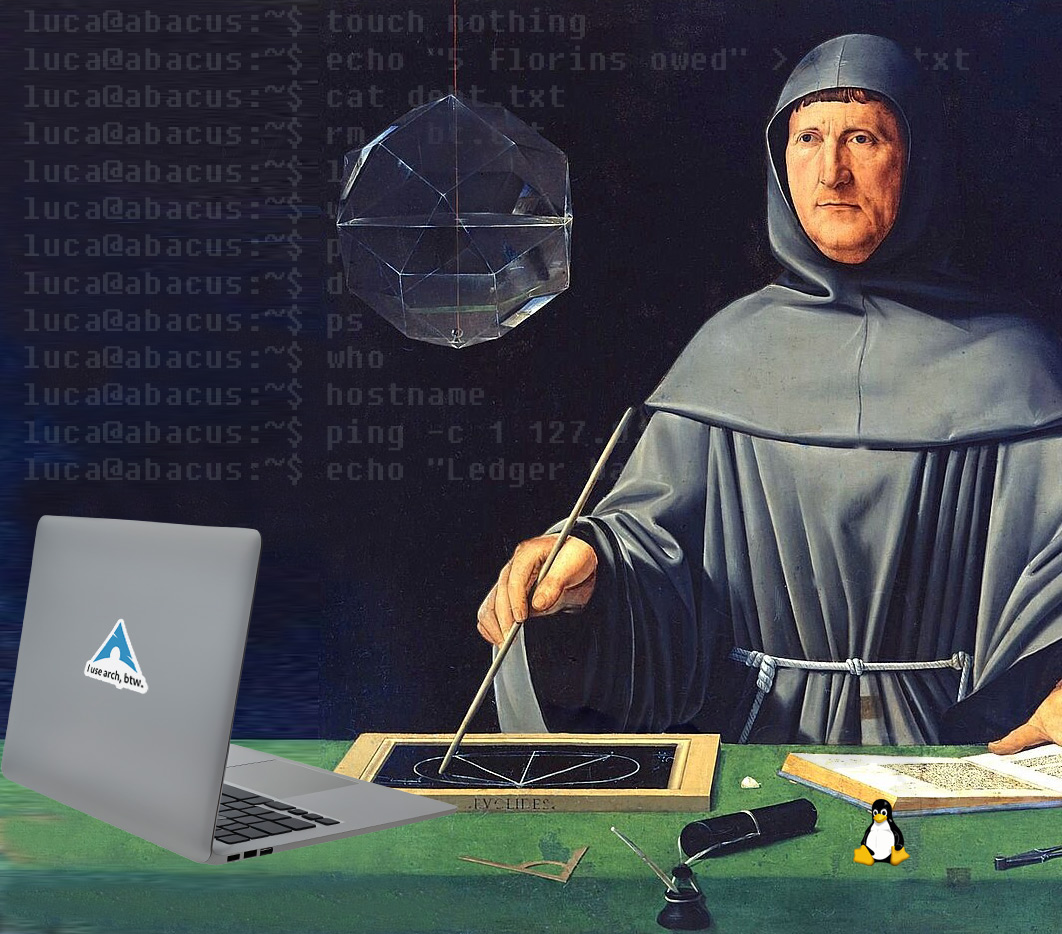
1494: Luca Pacioli performs the first recorded shell session
It’s practically a meme at this point. Any time the market share percentage on Statcounter so much as flickers, bloggers and op-ed editors pump out fresh articles proclaiming the glorious dethroning of the Mac/Windows Duopoly. “That’s it, folks! We are finally here: The Year Of the Linux Desktop!”
As a ghost-Redditor wrote over a decade ago:
The earliest reference we have of “Year of Linux on Desktop” is from Summa de arithmetica, geometria, proportioni et proportionalita by Italian mathematician Luca Pacioli in 1494. He writes: “Sono sicuro che il prossimo anno tutti utilizzerà Linux.”[deleted] • 11y ago
So yes, it has probably been “The Year of the Linux Desktop” for longer than it hasn’t been. It’s Schrödinger’s Year of the Linux Desktop: Simultaneously the Year and not the Year.
The Flickering 3%
Let’s not get ahead of ourselves. At the time of this writing, Linux desktop market share barely tickles the 3 percent mark. And sure, between the EOL of Windows 10 this year, the general encrappification of Win 11, and an overall exhaustion with the pervasive “product as service” mentality, a lot of people are flocking to Linux. The fact that more and more YouTuber/influencer types are embracing it has also made it more appealing to the unwashed masses (their words, not mine).
The “Old Linux” Experience
For me, Linux Desktop was always the last rite of passage for old, broken, and unused hardware. Whenever I had an old laptop lying around that was effectively useless, I’d say, “Before throwing it out, let’s install Linux and see what happens.”
I remember a distant time in 2005 when a friend who had fully gulped down the Linux Kool-Aid told me: “I switched to Ubuntu, never going back, bruh.” Or when an educational company I worked for at the time decided to switch all their staff laptops to OpenSuse or something.
Sure, it worked. Kind of. But I could never shake the feeling of general jankiness. Linux desktops always felt like the health-food-store version of computing: ethically sourced code, massaged by artisanal maintainers, but fundamentally janky and ugly. Think XFCE or KDE 3 era.
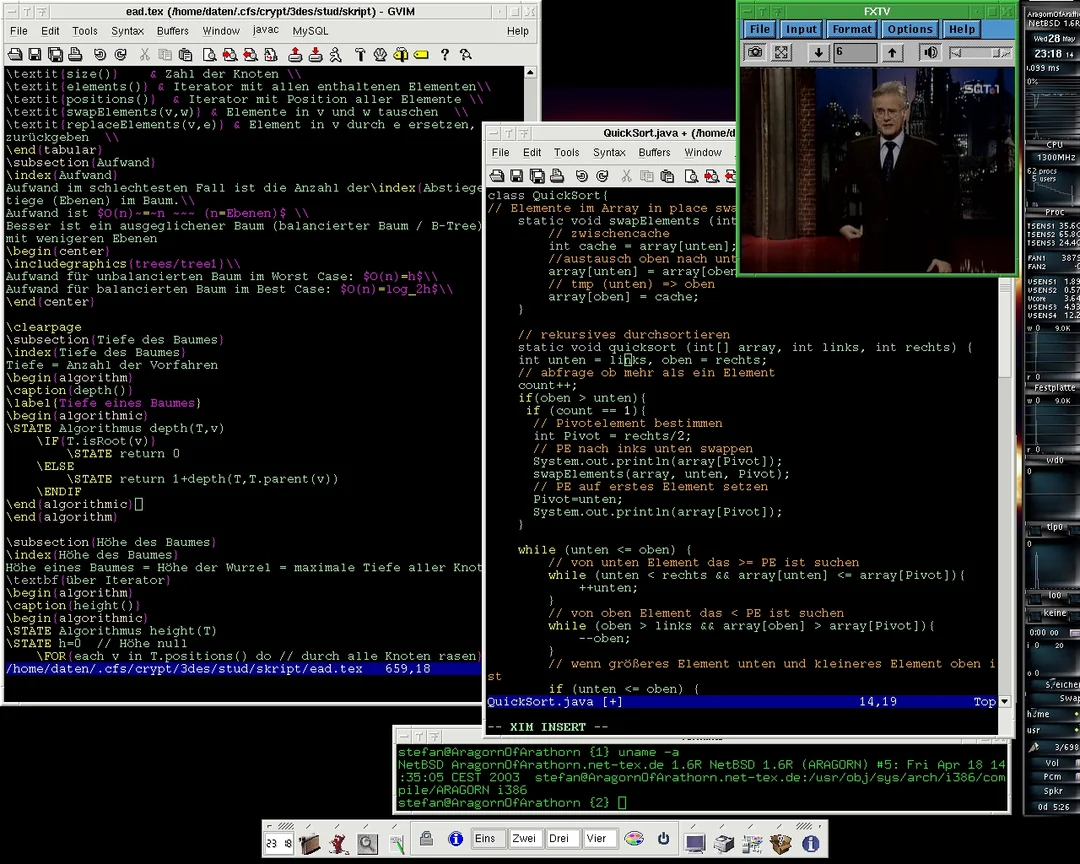
XFCE (2003) – screenshot by 0xKaishakunin
So yeah. I still enjoyed tinkering, but as a daily driver? No way Jose.
The Turning Point (Fedora)
Everything changed early this year when my main laptop decided it was time to join the choir eternal. Its battery was the first to go, weakly signaling, “I’m tired, boss,” while the CPU silently pined for the cool peace of the eternal compiling grounds.
So I thought: Okay, buddy. Before we give up, let’s just slap Linux on as a little parting ceremony. Having previously been annoyed with Ubuntu, I went with Fedora Workstation this time, using Gnome as the Desktop Environment.
And to my utter surprise, not only did everything look and feel extremely polished, everything just worked (except the fingerprint reader, but that’s the Achilles heel of all Linux laptops). Wi-Fi, Bluetooth, what have you—everything worked out of the box. No configuration, no compromise.
And yes, the triple-buffering madness of Gnome’s Mutter chugged battery cycles even harder than Windows, but man, was it beautiful.
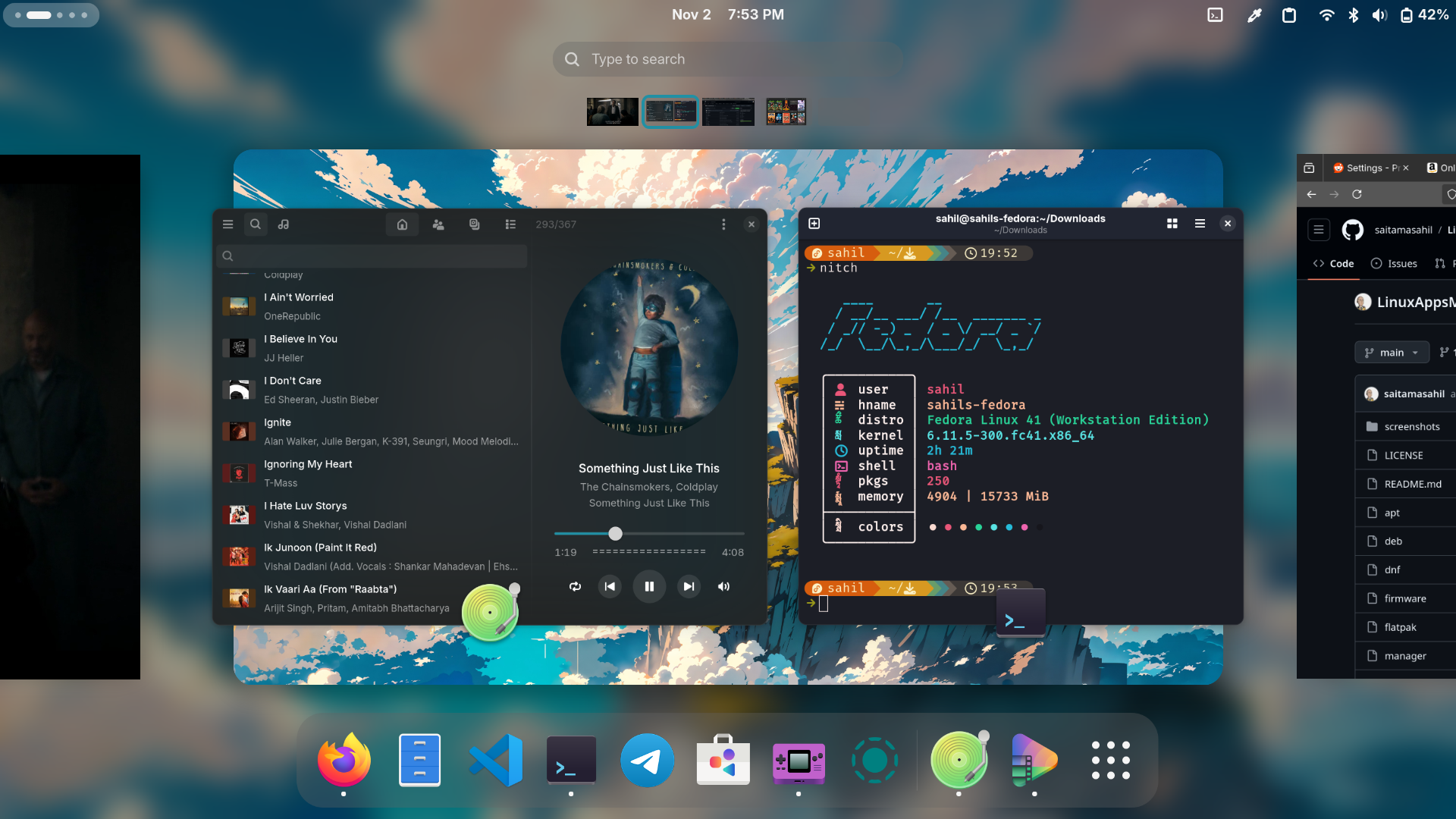
Fedora 41 with Gnome 47, screenshot by sahilmanchanda1996
So I moved in and started re-arranging the furniture, using it as my daily machine, eventually landing on Hyprland (until I broke it, but that’s a different story) and, crucially, actually getting work done.
Eventually the battery broke down completely (R.I.P.), but I had “licked blood,” as we say in German. I had finally tasted the power of the modern Linux desktop.
The CachyOS/Daily Driver Era
And so when it came time to shop for a new laptop, I intentionally picked a machine that had high chances of playing nice with Linux.
By the way, there’s nothing nicer than unboxing a new laptop, seeing that whole Windows 11 activation ritual, just going “nope,” popping in a USB stick, wiping the whole thing, and installing Linux.
Since I had actually done my research this time, I decided on CachyOS, one of the distros that has been gaining a lot of traction recently. Coming from many years of Ubuntu and Fedora experiments and never having used Arch (btw) before, I was initially skeptical. But now I’m convinced this is probably one of the best Arch-based distros out there for anyone who doesn’t hate their life and prefers to avoid raw-dogging the Arch install via CLI.
But I digress.
I’ve now been using Linux as a desktop for almost a full year, and it has completely changed the way how I think about computers in general and development in particular.
First of all, I love how it makes you stop feeling like a mere user or consumer of the desktop. You’re an active participant of the UI/UX. Don’t like something? Change it. Need something to work in a specific way? Write a shell script, a quick Python utility, or even a Qt app.
It may just be a case of correlation not causation, but my dev work this year has been through the roof. Tons of cool projects actually shipped and in production, and that’s to say nothing of all the custom tooling, little scripts, and quality-of-life stuff I’ve built over the last few months—small, targeted utilities like an automated Gmail checker with one-click KDE notifications for archiving nonsense, a custom taskbar hack to give VSCode native-like tabs (see below or read more), and scripts that update firewall settings across multiple VPN boxes without touching a single UI.
So yeah, I don’t care if 2025 was the Year of the Linux Desktop for everyone. It certainly has been for me.
It feels like there’s now a perfect balance: the general jank in distros has either decreased sufficiently, or machine performance has increased sufficiently to smooth it over. Using the Linux desktop in 2025 no longer feels like some “fair trade” or computer lab experiment. It has matured significantly.
And personally, I can’t imagine ever not using some form of Linux desktop as a daily driver.
Note: My main office machine is still running Windows (with all the jank) for various backwards compatibility, testing, and proprietary legacy software needs. So I generally bounce between that and my CachyOS/KDE laptop.
But guess which machine is actually enjoyable to use? The one where it feels like you’re not just a tenant, where you’re not fighting the OS every step along the way, but can just settle in, focus, and get shit done.
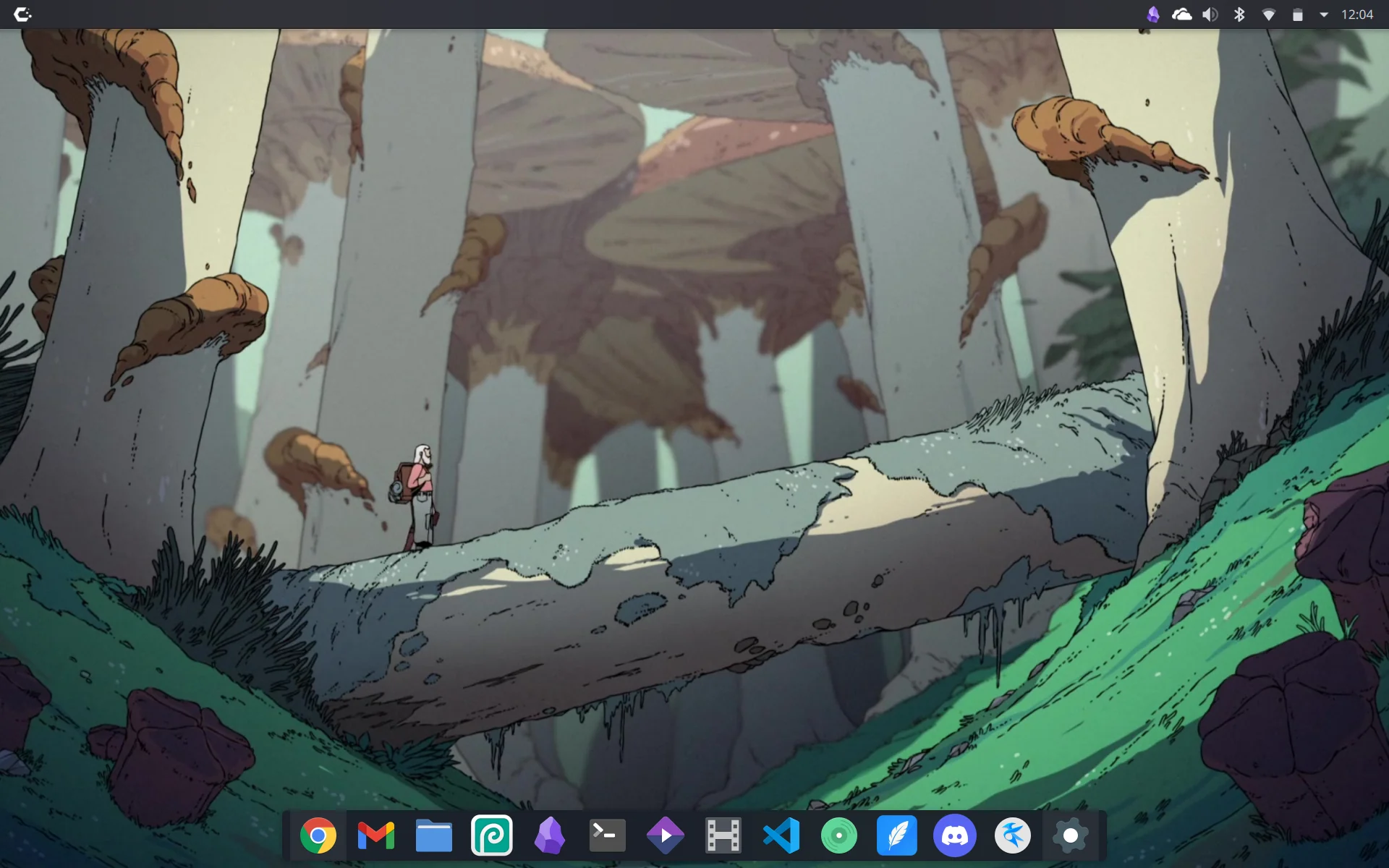
CachyOS/KDE. Icons: Papirus. Wallpaper: Scavengers Reign
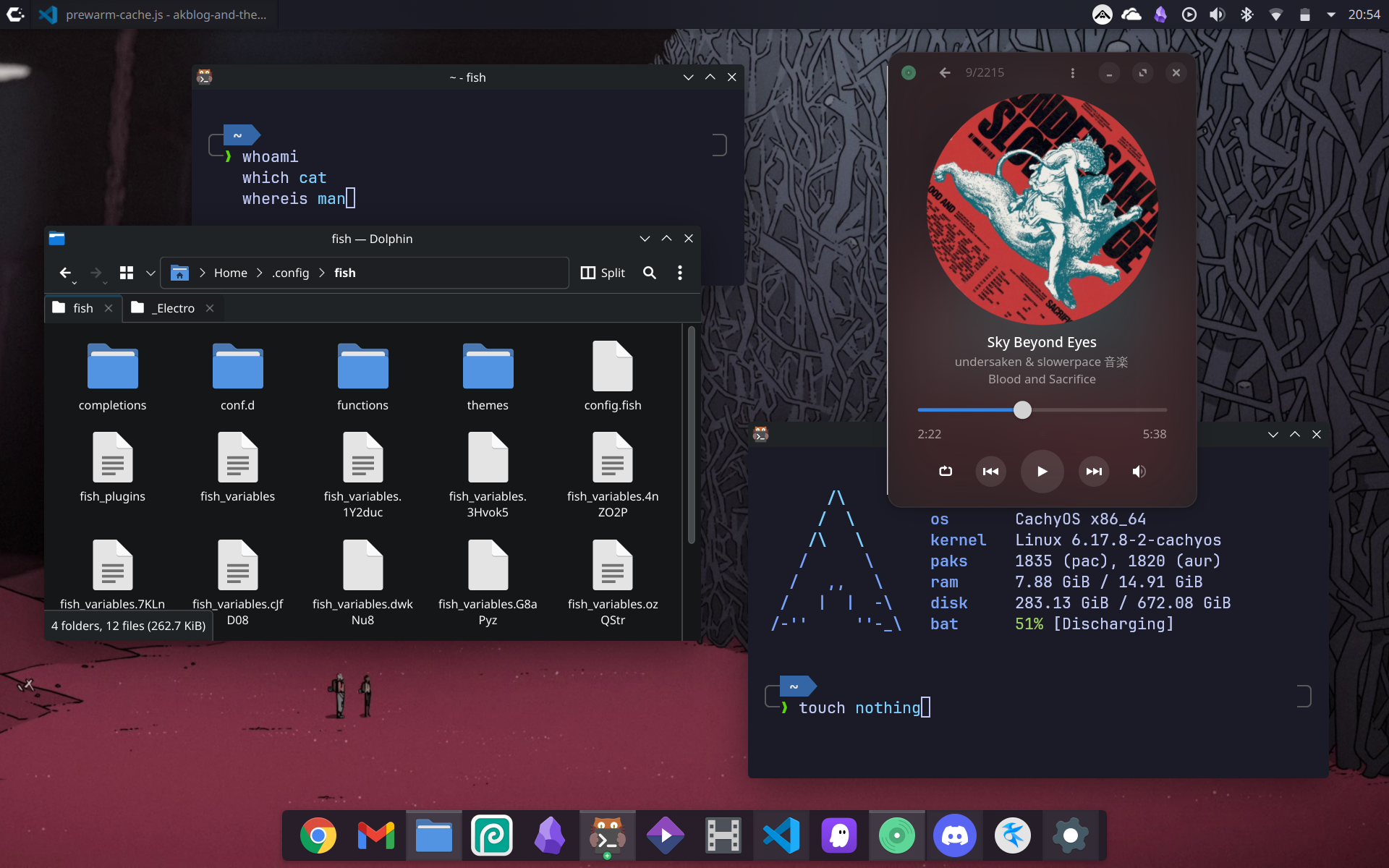
Kitty (fish/tide), Dolphin and Gapless. Wallpaper: Scavengers Reign
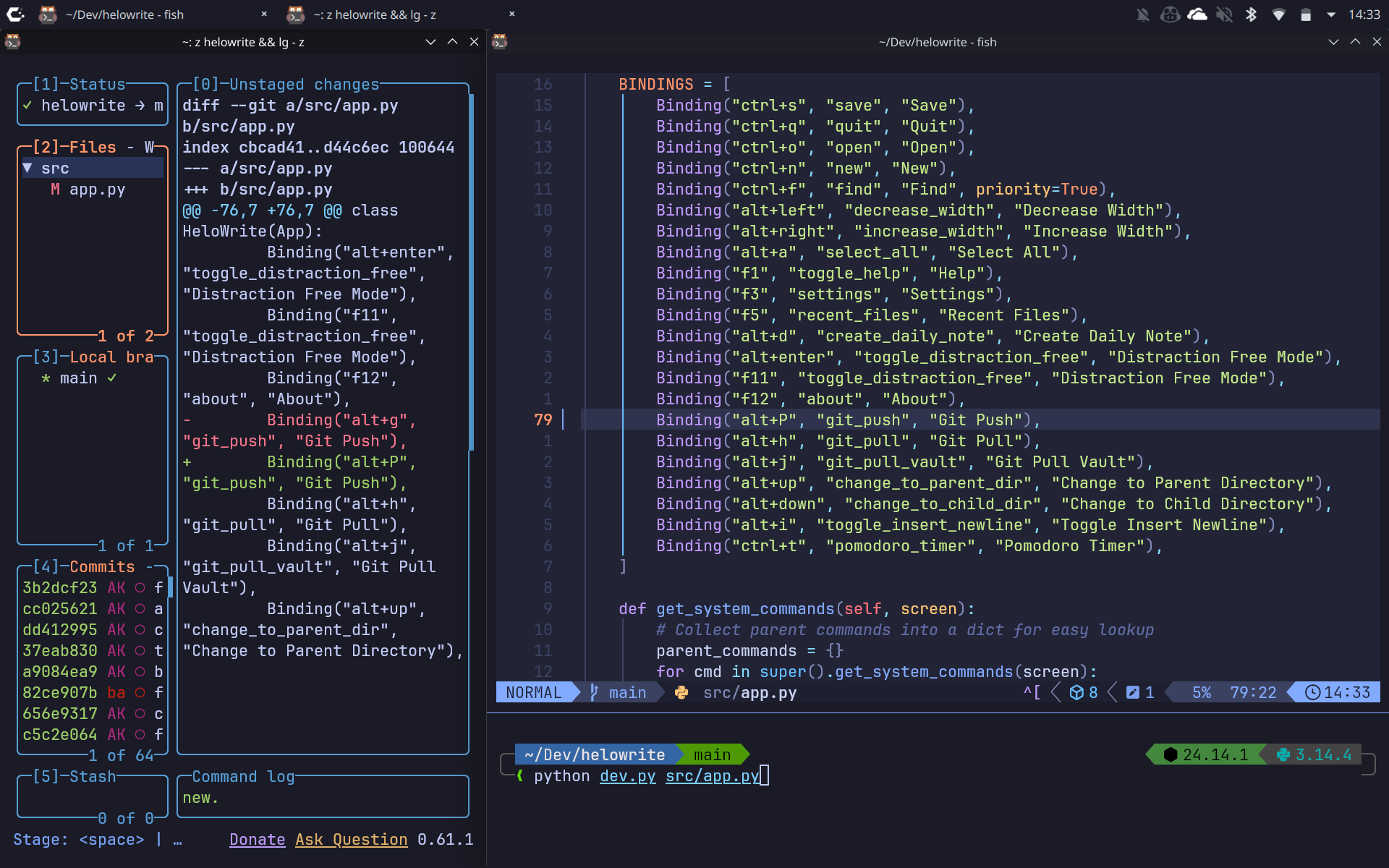
lazyvim and lazygit, working on helowrite
–