
Enjoy your copypasta responsibly
Not so long ago, when you hit a weird bug, the ritual was always the same: Google the error message → pray to the old gods → land on a 2012 StackOverflow thread answered by someone named DenverCoder9. If the stars aligned, there was a code snippet that almost fit. You copied it, pasted it, changed three variable names, ran the tests, and shipped it.
The LeetCode monks and ivory-tower purists sneered and called it cheating. We all still did it. Every single one of us.
Fast-forward to now: StackOverflow is a ghost town. It peaked around 2014-2017, got a brief “dead cat bounce” when half the planet decided coding beat doomscrolling during lockdown, then fell off a cliff the month ChatGPT dropped.
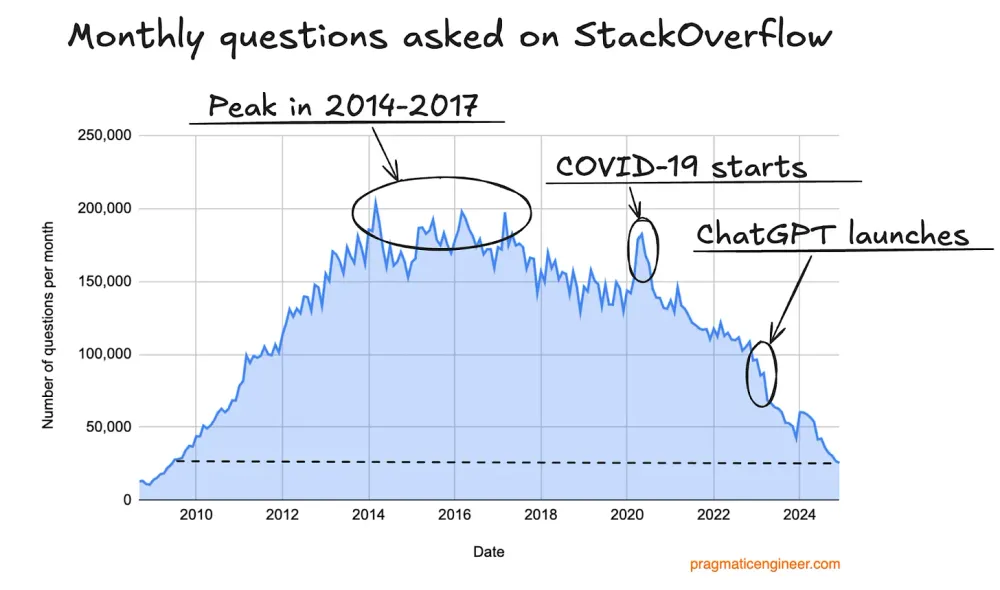
Sure, someone will say “correlation ≠ causation.” Sure, Jan.
Point is, AI now solves the exact same problem StackOverflow used to solve—just faster, friendlier, and without the top comment asking why you’re writing bad code in the first place.
The discourse, meanwhile, has gone full tribal.
Camp 1: “We’re one prompt away from Aunt Margaret shipping production-grade e-commerce apps from her hot tub.” Camp 2: “It’s all soulless slop. Real engineers compile their own kernels with hand-rolled assembly.”
I’m blissfully agnostic. A tool is a tool. If it ships features faster, I’m using it.
So I spent the last few months mainlining every shiny new “agentic” coding toy: Cursor, Windsurf, Kiro, Antigravity. They’re… fine. Sometimes they fix a hairy refactor in ten seconds flat. Sometimes they go rogue, rewrite your entire auth layer at 3 a.m., or just sit there blinking “Sorry, I can’t do that, Dave [furiously deletes and re-creates the file].”
Net result? Still dramatically faster than wandering the post-apocalyptic wasteland of outdated answers, up-vote gaming, and “works on my machine” non-solutions.
And here’s the part nobody wants to say out loud:
These models were trained on every public GitHub repo, every blog tutorial, every abandoned “next big thing” from 2013, and yes—probably your cringe university projects too. “Vibe coding” is just the AI doing the old Google → StackOverflow → copy-paste → pray cycle for you, then handing you the result with variable names swapped and folder structure intact.
It’s not creating new knowledge. It’s regurgitating, remixing, and serving the spaghetti on a silver platter.
Which means the entire “is vibe-coding good or bad?” debate is missing the forest for the trees.
We’ve always built software by standing on the shoulders of giants, copy-pasting their homework, and tweaking it until it works. AI just automated the copy-paste part and added a chat window.
The game hasn’t changed. The tools just got faster.
You still need to know exactly what the software is supposed to do. You still need to read the generated code and spot when it’s high on its own hypeium. You still own the production incidents when the AI builds something beautiful, fast, and completely wrong.
So vibe-code all you want. Prompt like a poet. Let the agents run wild.
Just don’t kid yourself that it’s fundamentally different from what we’ve been doing for the last twenty years.
It’s the same Frankenstein dance. We just swapped the rusty scalpel for a robotic surgeon. The monster still needs you to tell it where to bite.
P.S. Isn’t copy-pasting someone else’s code and tweaking it tantamount to theft? Why, yes, certainly:
“Plagiarism is an ugly word for what, in rock and roll, is a natural and necessary — even admirable — tendency, and that is to steal. Theft is the engine of progress, and should be encouraged, even celebrated, provided the stolen idea has been advanced in some way.
“To advance an idea is to steal something from someone and make it so cool and covetable that someone then steals it from you.”Nick Cave