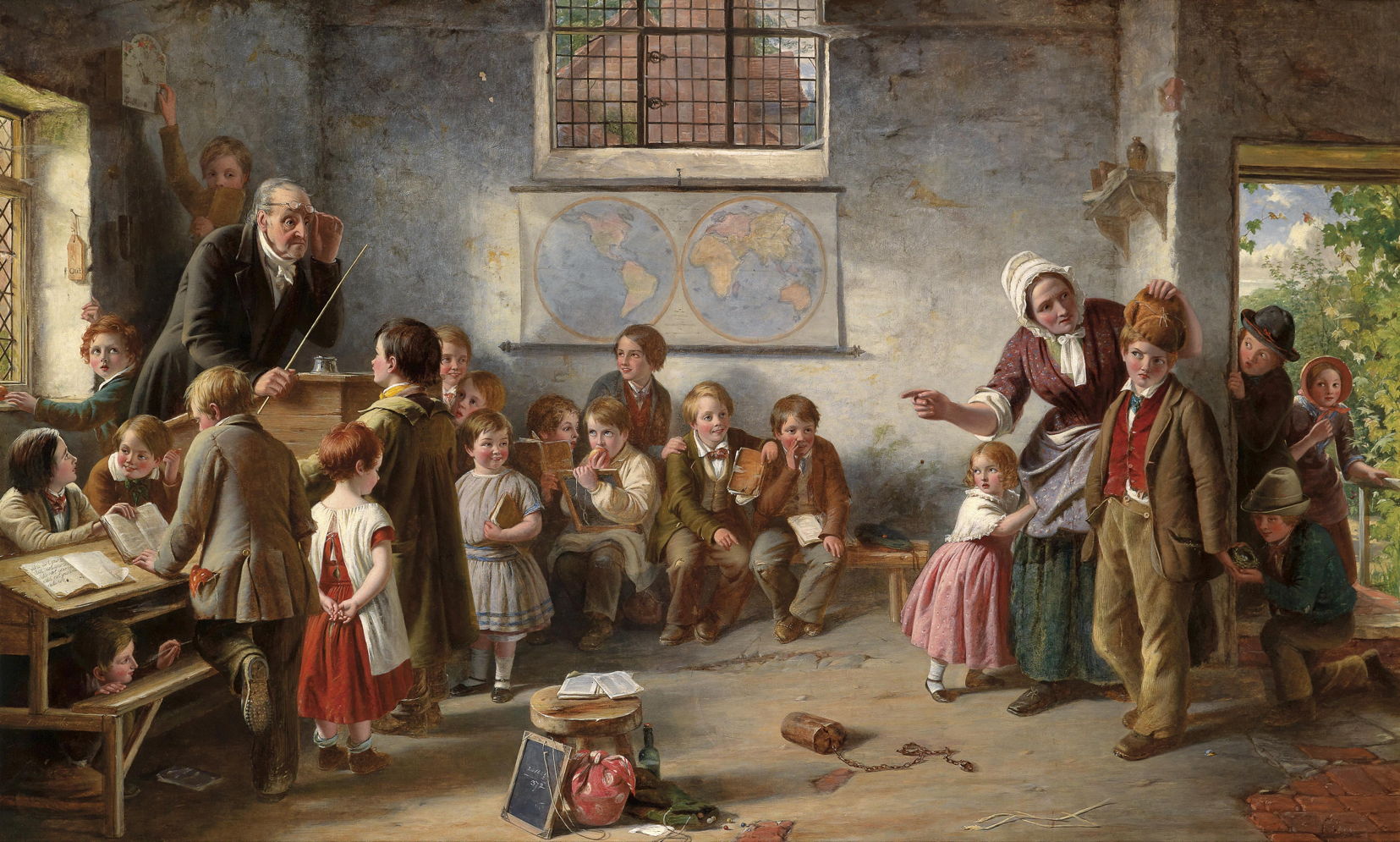
Thomas Brooks – The New Pupil (1854). Wikimedia Commons.
You’ve probably seen that Current Affairs piece making the rounds, the one that declares higher education dead because “students use AI to write papers, professors use AI to grade them, degrees become meaningless, and tech companies make fortunes.”
It’s a catchy obituary. And yeah, AI panic is having a moment. Programmers sneer at “vibe-coding,” artists rage at image generators, and now academics are convinced ChatGPT is the final nail in the coffin of human learning. When factory jobs vanished to automation, knowledge workers mostly yawned. Now the machines are coming for their gigs too, and suddenly it’s existential.
Linus Torvalds put it bluntly in a recent interview: “that genie is out of the bottle.” No amount of wishing will stuff it back in. We’re all going to have to live with this new reality.
I’m a writer, an educator, and a developer—three professions currently getting torched by generative AI—and I’m not scared. I’m genuinely excited.
This whole freakout feels eerily familiar. Remember when Wikipedia launched and every teacher warned us never to trust “the internet”? The same generation that preached that gospel now doom-scrolls rage-bait and falls for foreign disinformation campaigns. The pattern is unmistakable: new tool arrives → disrupts old hierarchies → experts clutch pearls → tool wins anyway.
AI didn’t break education. It just held up a mirror we’d spent twenty years trying to avoid.
Here’s the part no one wants to say out loud: institutional education has been coasting on fumes for decades. When I was studying to become a high school teacher, I got so fed up with standardized testing and fossilized curricula that I dropped out and started my own language-teaching business. That was ten years ago. Walk into most classrooms today and you’ll see the same worksheets, the same “summarize in your own words” assignments, the same obsession with memorizing facts that Google rendered obsolete in 2004.
We pretended the internet didn’t exist, then we pretended smartphones didn’t exist, and we kept designing assessments that rewarded regurgitation over reasoning. Of course students plug those assignments into ChatGPT. The surprise isn’t that they’re doing it, it’s that we built an entire system that made it the rational choice.
AI didn’t break education. It just held up a mirror we’d spent twenty years trying to avoid.
So here we are, at an actual crossroads. One path is easy: ban AI, block it on school networks, run plagiarism detectors that are already obsolete, and keep shouting that the kids are cheating. The other path is harder: accept that the tool is here to stay and figure out how to make it work for us instead of against us.
I still remember my high-school math teacher confiscating calculators because “you won’t always have one in real life.” We now carry devices in our pockets more powerful than the computers that put humans on the moon. Telling students they can’t use AI because “you need to know it yourself” is the modern version of that same lazy argument.
Brains were never meant to be Wikipedia. Recalling disconnected facts on command has never been a meaningful proxy for intelligence. Real thinking—creativity, insight, synthesis—happens when we connect ideas, spot patterns, and wrestle with complexity. Funny thing: that’s exactly what large language models are starting to do.
So maybe, just maybe, we should stop treating AI like the enemy and start treating it like the most powerful tutor humanity has ever built.
A couple of starting points for anyone willing to experiment:
- Turn AI into a Socratic sparring partner. Instead of asking it for answers, lay out your reasoning and dare it to tear holes in your logic. Use every response to sharpen the next prompt. That back-and-forth is where real learning happens.
- Flip assessment from product to process. Stop grading the polished essay or the “correct” answer. Start grading the prompt history, the iterations, the dead ends, the moments the student pushed back against the model or combined three different outputs into something new. The artifact no longer matters; the visible thinking does. AI can’t fake intellectual courage or curiosity, at least not yet.
- Let teachers become learning-experience designers. With a few good prompts, even non-coders can generate interactive exercises, simulations, and adaptive quizzes tailored to their students, without waiting for admin to cut six-figure deals with software vendors. The barrier to building great tools just dropped to zero.
So yeah, if your homework assignments can be completed better and faster by a large language model, they were probably busywork to begin with. That’s not a tragedy; it’s an invitation.
Education isn’t dying. It’s being forced to evolve for the first time in a century. We can fight that evolution and lose, or we can lead it.
I know which side I’m on.