
[drop_cap]E[/drop_cap]arlier this year I found myself at a crossroads. Spotify’s recommendation algorithms hadn’t been what they used to be for a long time. I noticed they kept serving up the same lazy “safe picks” over and over again …
When my wife kept asking me, “Hey, it keeps recommending that one song, how do I skip it?” I googled it and, to my utter befuddlement, discovered there’s currently no way to tell Spotify “don’t play that again, Sam!” even as a paying customer. On top of that, every time I tried to turn off those annoying videos (you’re a music app, you have one job: play music!) they re-enabled themselves after an update.
Then I started reading horrifying articles about “ghost artists” and the proliferation of AI slop on the platform, not just tolerated but seemingly actively encouraged by management. It seemed that Spotify had just given up over the years. They weren’t interested anymore in music as art, but had shifted to music as commodity.
Fair enough. Since I was listening to lots of vaporwave and barberbeats at that time, and much of what I liked wasn’t available on Spotify anyway (thanks to its remixy, derivative nature), I thought: why not go back to the olden days where we actually managed and curated our own music libraries?
But the convenience of online music streaming had spoiled me. It wasn’t enough to just digitize the remainders of my record collection and dump it on an MP3 player. No, I wanted my music with me everywhere, on multiple devices, on my phone, streaming to Chromecast, the works.
A quick browse through available solutions for modern music self-hosting quickly led me to projects like Plex, Navidrome, and Jellyfin.
I liked the look and feel of Jellyfin, so I decided to give it a whirl. First order of business: grab a crusty old netbook from my refuse pile of forgotten hardware.
For an operating system I went with DietPi, which is, as the name suggests, a trimmed-down version of Debian with some nice quality-of-life features like easy installers for popular self-hosting stuff like Pi-hole and Jellyfin.
I gave it a fixed IP in my home network, installed Jellyfin, dropped in my media library, and boom: it just worked.
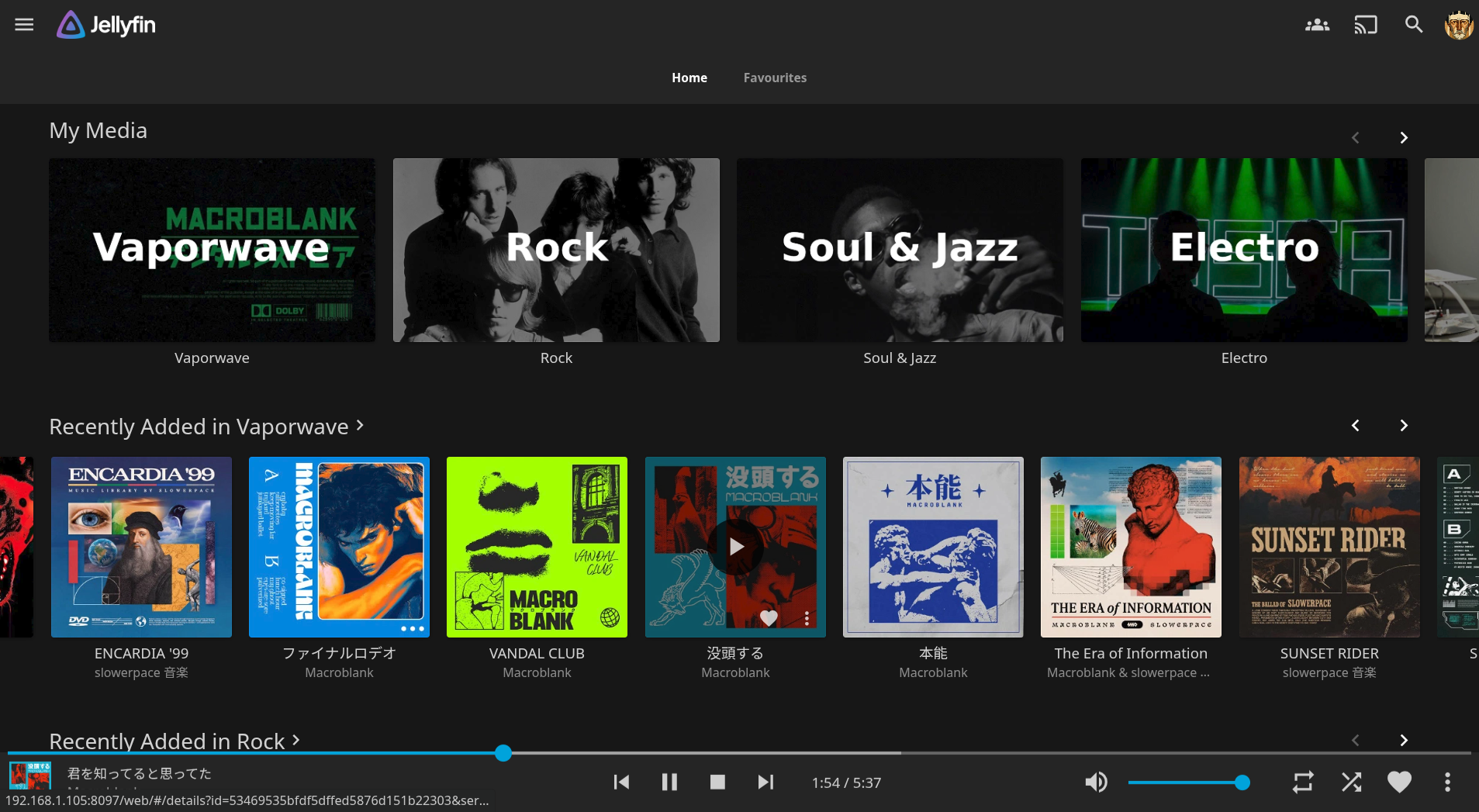
JellyFin’s web UI
It’s now been 10-11 months since that early-year frustration with Spotify finally became too much. I canceled my subscription in February and haven’t looked back since.
I’m still listening to just as much music as before, but now I actually enjoy the experience again. No more slop playlists, no more twitchy videos. Don’t like a song? Just delete it.
Managing my music library has actually become a fun experience–one of those things you don’t realize you missed until you come back to it. Making sure all the metadata and covers are correct, pruning stuff I never actually listen to. (I highly recommend Picard for the metadata stuff.)
Yes, there are some technical challenges to overcome, like making Jellyfin accessible outside your home network without accidentally inviting the entire internet into your living room. But there are many good tutorials online on how to achieve this. For example, via Tailscale or a reverse proxy.
The trade-offs are certainly worth it, though. Not only do I now have my own music library running 24/7 on that crusty old netbook with a 1GHz Atom chip and barely 1GB of RAM (ha!), with Jellyfin you can also use a bunch of different clients for playback.
Their web interface is already very nicely done, but for daily use on my laptop and at my desk I generally prefer Feishin, which just looks and feels sleek.
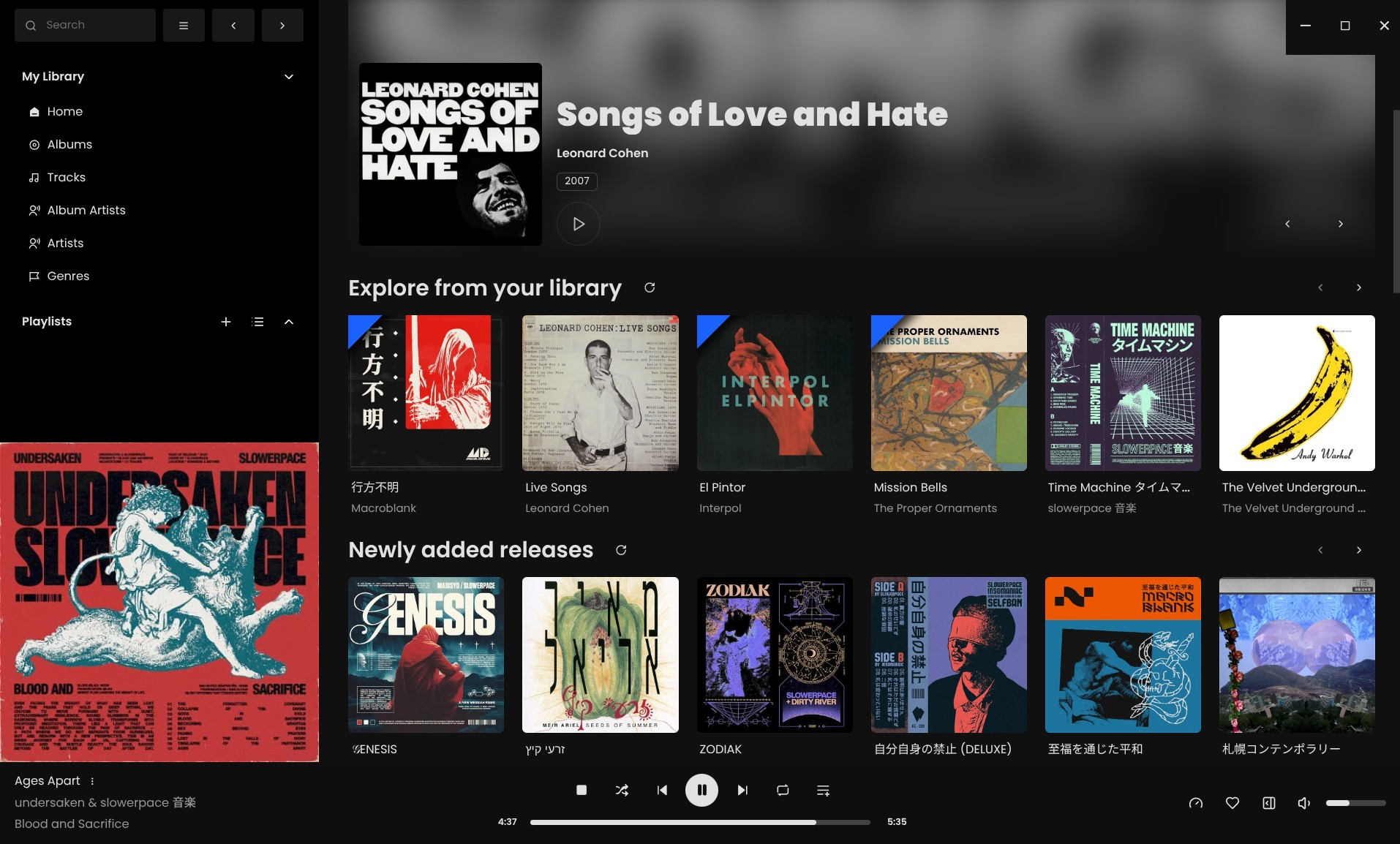
beautiful UI, cross-platform app
For Android I can’t praise Symfonium highly enough. It’s not free, but worth every cent. And no subscription nonsense.
Would I recommend others yeet their Spotify subscription into oblivion as well? If you have some old hardware lying around and aren’t afraid to delve into the world of self-hosting, go for it! At the very least it can be a fun weekend project. And who knows, maybe you’ll end up loving it and embracing it as your go-to music solution as well.
–