
Negev Nubian Ibex by Joerg
The canonical collection of Hebrew writings known as Tanakh is one of the cornerstones of human civilization. Not only is it the foundational text of the Hebrew people, but it also provides the source code the two biggest religions on the planet were forked from.
If, for a moment, we step back and leave all the issues of “sacredness” or questions of improbable authorship aside, we find ourselves with just the text itself.
It’s a remarkable piece of writing, spanning many different genres and styles, from the sprawling epic of the Exodus, to the stark lamentations of the prophets, to what appears to be mere genealogical “bookkeeping” records in Chronicles, to the intricate poetry of Psalms or Song of Songs.
But it’s not just its vastness or its ancientness which makes these writings somewhat inaccessible to modern readers, it’s ultimately its Hebrew-ness which poses the biggest stumbling block to appreciating this text for what it is.
As someone who has been learning modern Hebrew for many years now, I keep coming back to the fact that ultimately, it all starts from the Tanakh. This is the source code. And if you really want to understand this language, there’s no shortcut. You have to go upstream.
Translating the Tanakh is challenging because ancient Hebrew and modern languages work very differently. Hebrew is built on roots that carry clusters of related meanings, so a single word can suggest multiple ideas at once. Many Hebrew words span broad semantic ranges with no exact counterpart in other languages, and much of the Bible’s poetry relies on rhythm, sound, and wordplay that cannot be reproduced.
For example, take the word “Adam”. In English it’s just a bunch of random vowels and consonants. But in Hebrew it’s close to “Adamah” (earth), so he’s literally coming from the earth, he’s an “earth-man” or “earthling” if you like.
Or take these two sentences from Isaiah 5:7:
וַיְקַו לְמִשְׁפָּט וְהִנֵּה מִשְׂפָּח
לִצְדָקָה וְהִנֵּה צְעָקָה
English translations will usually say something like “He looked for justice, but saw bloodshed; for righteousness, but heard a cry of distress.”
Sounds dramatic, alright? But it misses the poetry of the Hebrew completely:
- mishpat – מִשְׁפָּט (justice) vs. mispach – מִשְׂפָּח (bloodshed) – same letters with one swapped.
- tzedaqah – צְדָקָה (righteousness) vs. tze’aqah – צְעָקָה (cry) – rhyme + contrast.
Translations are fine, but they fail to capture even a glimpse of the literary genius hidden in this text.
The problem is, if you want to engage with the original writings in a fresh way, you’re kind of stuck.
Most Bible reading apps fall into one of two camps: academic tools drowning you in cross-references and commentary, or devotional apps serving up bite-sized inspiration with your morning coffee (including up-sells and subscriptions). Almost none of them are designed for the simple act of reading – sitting with the text, verse by verse, without distraction or agenda.
So I built one that does exactly that.
Tanakh Reader is a simple but focused application that follows the old UNIX adage of “do one thing and do it well”: read the Hebrew text in a direct and distraction-free way.
It is not designed to be a full-featured cross-reference academic apparatus. In fact, exactly the opposite.
The philosophy behind this application is simple: here is the Hebrew text (with nikkud) in beautiful clear typography, dark mode, full responsive layout, and perhaps most importantly a special “deep focus mode” that lets you parse one verse at a time. No scrolling, no skimming. Just you and the text, inviting the kind of attention these words were meant to receive.
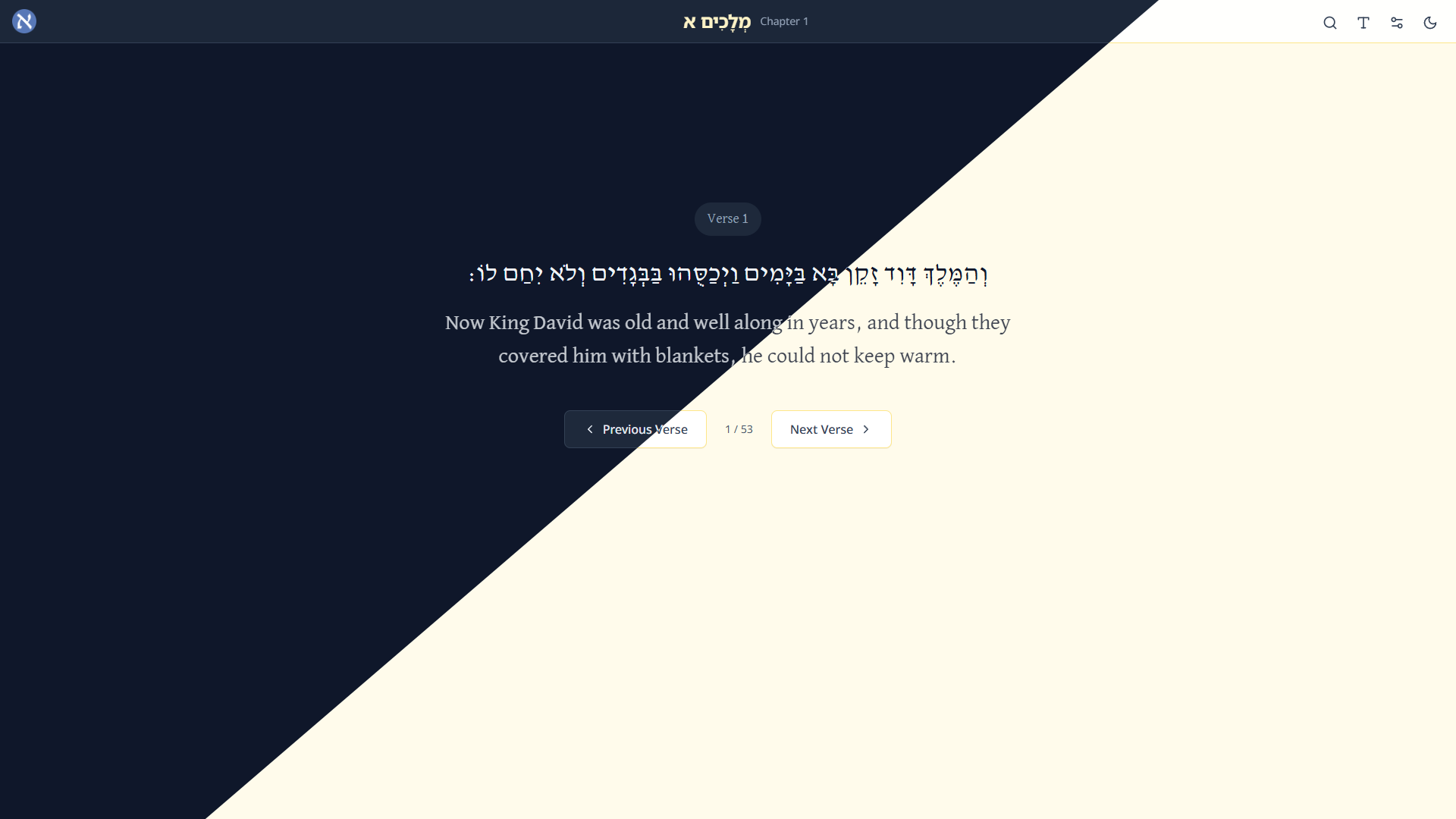
deep focus mode: one verse at a time (can be toggled in settings)
Of course there are translations too. Together friends from around the world I’ve integrated Portuguese, French, German and even Chinese so far. But these sit alongside the Hebrew, not in front of it. The text comes first.
At its heart Tanakh Reader has just one job: letting you read the Tanakh, without noise or clutter.
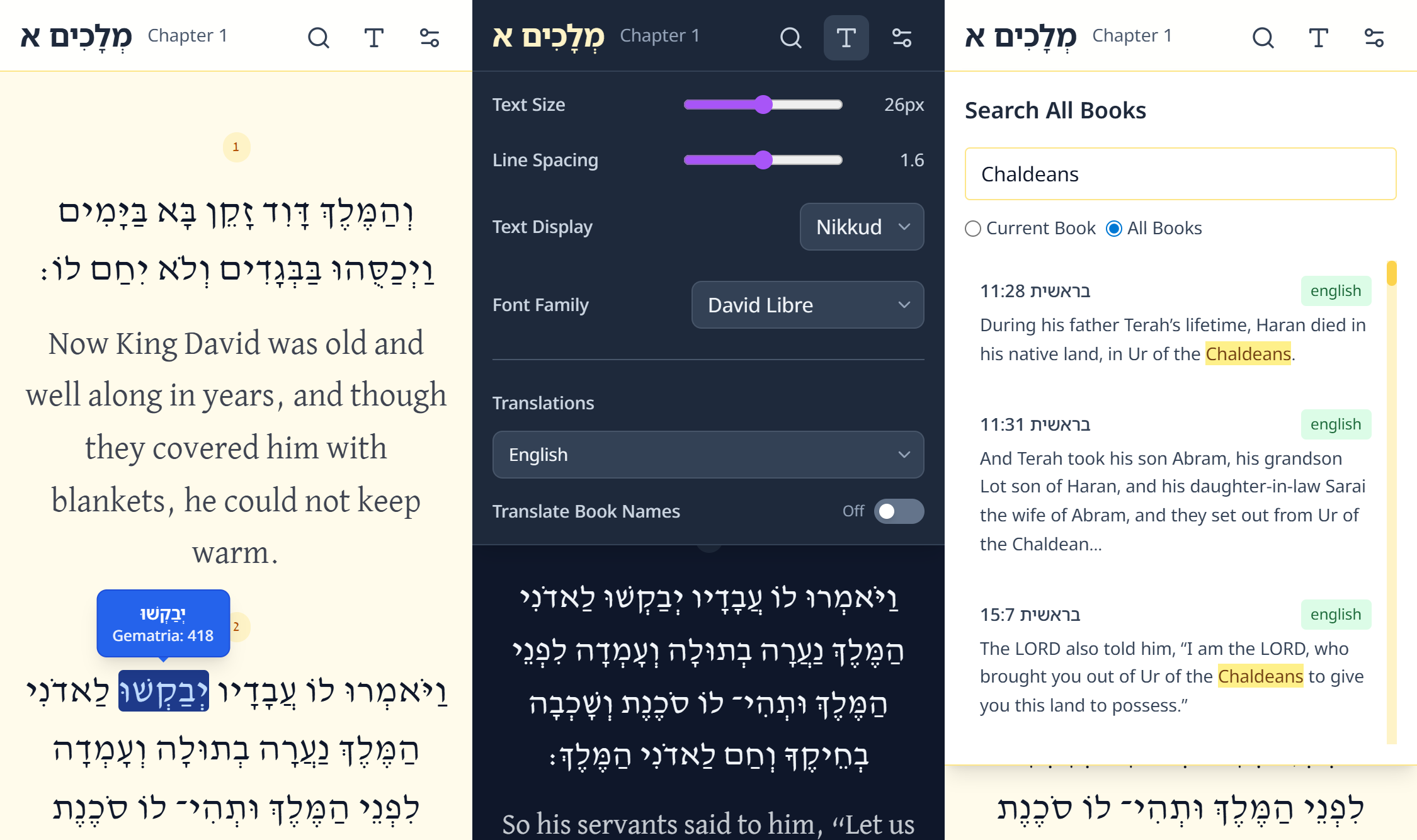
mobile screens
Tanakh Reader is built with React/Typescript and can be accessed in any browser or installed as PWA (progressive web app).
Note: the complete core text is “baked” right into the build. No API calls needed. Books and translations are lazy-loaded on demand.