Ever since Omarchy Quattro released a few days ago, the web has been abuzz with hype around this ambitious update focused on making the most “malleable” operating system.
It’s been somewhat of a meme for a while now that Omarchy isn’t a “real” distro but just DHH’s Arch/Hyprland dotfiles, and while I never particularly agreed, I could see where people were coming from.
Omarchy Quattro is an entirely different beast however. Because by its very nature, it’s very un-dotfiles-like.
What do I mean by this?
In regular Hyprland/ricing culture, any cool thing you want to add to your desktop usually becomes a sprawling mess of packages and config files. You are always at the mercy of upstream and one pacman -Syu away from breaking your widgets, waybar modules, wallpapers, theming, etc.
Why Quattro Is Different
Earlier versions had already solved the theming issue and built a solid foundation where everyone could easily create their own themes and share them, all based around common centralized patterns.
Omarchy 4.0 now did the same thing for functionality, by fully embracing quickshell. In other words, every bar tool, widget or other customization is running within the same shell, easily shareable, plug-and-play, no package dependency hell, no .config sprawl (at least in theory).
Because Quattro plugins are generally built off shared agent skills for structure and common UI elements, they tend to share the same visual language instead of looking like a dozen different design philosophies slapped together, which is something the KDE Plasma Store has long suffered from.
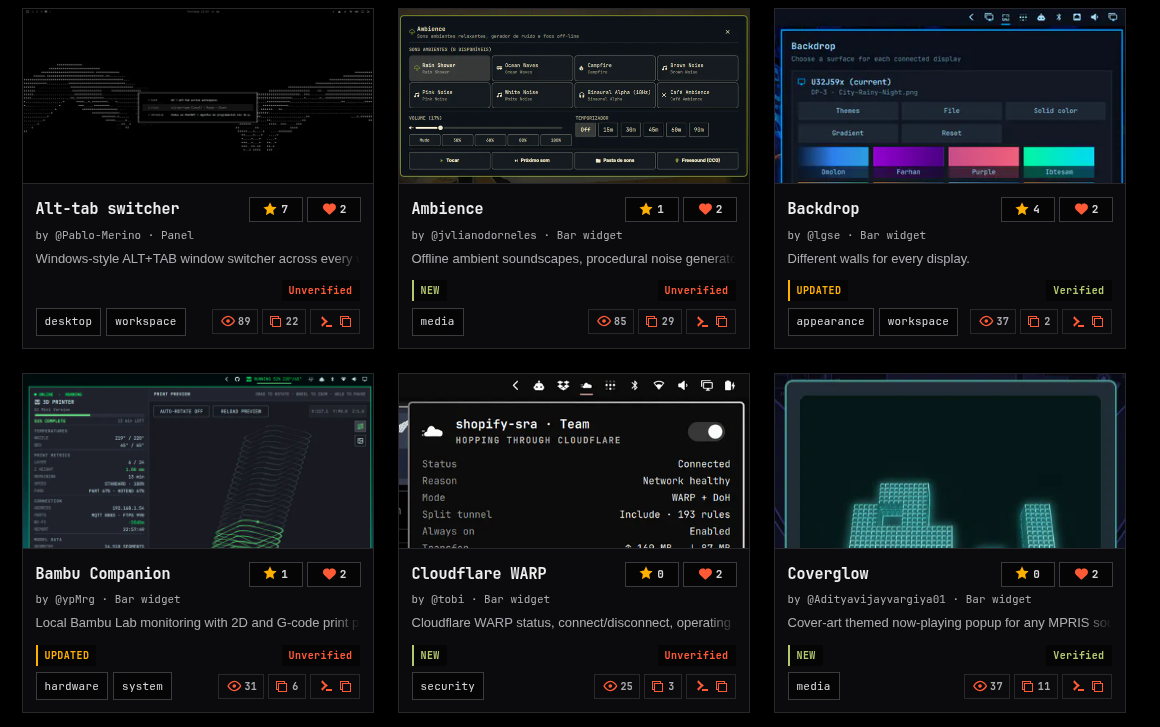
Almost all Omarchy plugins hook directly into global themes and natively follow system colors
The Omarchy Community Plugin Marketplace has seen a staggering number of submissions so far and the queue shows no sign of stopping.
Which brings me to my central point.
The WordPress Playbook
WordPress was never the best possible blogging platform. In essence it was just a fork of b2/cafelog. What turned it into a behemoth was its themes and plugins ecosystem.
If WordPress Core didn’t do something you needed, there was a high chance someone had written a plugin for that. If not, you could just write your own and share it.
And yeah, I know, WordPress isn’t exactly at the center of the hype-cycle these days. But WordPress still powers 41.2% of all websites and 59.0% of all CMSes, as per W3Techs. And again, that’s not because it’s the best or most capable CMS or blogging platform in some absolute sense, but primarily because of the ecosystem around it.
A linux distro and a content management system obviously isn’t the same thing. They serve very different needs for different people.
But the mechanism — plugins and themes for everything — is what makes Quattro’s approach genuinely interesting, especially when looking at how other distros have tried to solve the same problem.
“Don’t Touch That, You May Hurt Yourself”
For example, GNOME and KDE have their own extension ecosystems, but they’re tightly bound to a defined API. You can only do what the shell exposes hooks for. Flatpaks and snaps in Fedora and Ubuntu marketplaces give you more freedom but they are also annoyingly sandboxed and not exactly easy to just spin up for a quick utility.
Omarchy plugins are just git repos pulled straight onto your system. All gas, no brakes. It’s more akin to the wild west of the AUR or npm than the safe but padded walls of flatpaks and snaps.
But since most Quattro plugins are usually much smaller and more tightly scoped, attack surface is likely smaller as well (and I personally find the idea of “know what you install” more appealing than “don’t touch that, you may hurt yourself”).
The community marketplace does basic vetting. For example if a plugin can “inspect or change a system or user service lifecycle”, “install, upgrade, or remove software outside its own checkout”, etc. it gets flagged for security-review, and if maintainers see a problem, they will require fixes before it gets listed.
That doesn’t mean that one of these repos can’t push problematic stuff after it passes initial review, but at least it gets a basic inspection before being published.
At the time of this writing more than 300 plugins have been published already, with more constantly coming. If you search the community marketplace now, there is a high chance someone has already created something that does exactly what you need or at least something adjacent, so you can easily clone and modify it.
Here Comes the Slop
Since it’s the year of 2026, obviously, many of these plugins are “vibe-coded”. Probably goes for much of open source software these days. Make of that what you will.
Won’t the low barrier of entry to creating Quattro quickshell plugins with agents just lead to massive amounts of low-utility, questionable, and generally duplicated plugins for everything?
Maybe.
When we had to hand-code things line-by-line, developers generally concentrated their efforts onto existing codebases, slowly adding features, growing communities around projects.
And now, the cost of code has become so ridiculously cheap that anyone might just tell their LLM of choice “yo, make that thing”, before even bothering to check if a plugin already exists. It has become that easy. For better or for worse.
I’m not sure that’s necessarily a problem. AI-slop hasn’t killed Amazon KDP for example. People have been fire-hosing low-effort garbage into that marketplace since ChatGPT first dropped, and well-crafted stuff still finds an audience.
In the end, it’s probably just a discovery problem. Good projects will rise to the top, low-effort ones or shoddy clones should drop to obscurity, at least in theory.
We’ll see how it goes. Maybe in two months from now we will have fifty “Pomodoro timer” plugins or ten-thousand plugins that do nothing but open a folder or an electron app. Or maybe it will shake out into bigger, more popular plugins people will form communities around.
At any rate, it’s definitely a novel way to run a Linux distro. I’ve been playing around with a bunch of plugins over the last few days, wrote some from scratch, cloned others, etc. And it’s been a lot of fun.
WordPress didn’t get that far by staying tidy or “enterprise-safe”. It got there by providing a solid foundation millions of people could build upon. And Omarchy is making the same bet.